Complexity, clarity and a cast of thousands
A high-stakes digital transformation. A dispersed frontline workforce. And very little room for error.
A major Home Office programme was replacing ageing technology at the UK border with new digital systems. For more than 10,000 Border Force colleagues working across the UK and Europe, that meant significant change to the technology and processes they relied on every day.
I joined as communications lead at a critical stage of deployment. My job was to take something technically complex and make it clear, relevant and practical for the people who would actually be using it, often in busy, security-critical environments where getting change right really mattered.
That meant getting close to the people affected by the change, while also understanding a complex stakeholder landscape around them. I mapped stakeholders across the programme and wider organisation, working with operational, technical and senior leadership teams to understand where the change would have the greatest impact, where concerns might emerge and where communications needed to work hardest.
We built a network of change champions across sites, creating an important link between the programme and the frontline. It gave us a much better understanding of what people were hearing and experiencing locally, while giving local leads the information, tools and confidence to have useful conversations with colleagues on the ground.
A big part of my role was also developing communications capability within the programme. Several of the civil servants working in communications and stakeholder roles were new to the discipline, so I spent a lot of time coaching and mentoring them, helping them develop their skills, judgement and confidence while we delivered the work together.
The results gave us good evidence that the approach was working. Communications and engagement scored 4.2 out of 5, against a typical programme benchmark of 3.5, and our approach was described by the programme's Senior Responsible Owner as “gold standard.”
In a nutshell:
Led communications and engagement for a major Home Office digital transformation affecting 10,000+ Border Force colleagues across the UK and Europe
Mapped and managed a complex stakeholder landscape, using change impact and readiness insight to target communications where they were needed most
Built a network of change champions across sites, creating a two-way link between the programme and frontline colleagues
Turned complex technical and operational change into communications that made sense for people doing the job
Coached and mentored civil servants who were new to communications, building skills, judgement and confidence within the team
Achieved a 4.2/5 communications and engagement score, against a typical programme benchmark of 3.5, with the approach described by the SRO as “gold standard”
In a nutshell:
Built an internal and corporate communications function from scratch for a 2,900-person, 300+ practice veterinary group
Advised the Chair, CEO and Executive team on colleague communications, organisational change, reputation and sensitive issues
Led communications around a new workforce management system, balancing business change with the needs of a deeply people-centred workforce
Led colleague and leadership communications through Covid, providing clear, timely information across hundreds of practices
Managed external reputation in a highly emotive consumer sector where issues could quickly become sensitive or high-profile
Helped strengthen the organisation's corporate profile during a period of significant growth ahead of its eventual £1bn+ sale
A sector like no other
2,900 colleagues. 300+ practices. One new communications function. And a pandemic thrown in for good measure.
When I joined this leading veterinary group, communications amounted to a single PR consultant writing and placing press releases. There was no internal communications function, no consistent way of reaching colleagues and no real communications infrastructure for a workforce of 2,900 people spread across more than 300 practices. My job was to change that.
Working closely with the leadership team, I built the communications function from the ground up, bringing internal and external communications together and putting in place the channels, rhythms and relationships the business needed. I advised the Chair, CEO and Executive team on everything from colleague communications and organisational change to reputation and sensitive issues.
And this was veterinary care, where almost nothing is just a business issue. Clients are deeply emotionally invested in their animals, while the people delivering their care are equally passionate about what they do. Communications needed judgement, empathy and an understanding that the same issue could matter very differently to colleagues, clients and the wider public.
That became particularly important during the introduction of a new workforce management system, which changed working arrangements for colleagues across the group. And then Covid arrived. I worked directly with the leadership team throughout the pandemic, helping the business communicate quickly and clearly with hundreds of practices while providing the visible leadership colleagues needed at an extraordinarily uncertain time.
Alongside that internal work, I managed corporate reputation and external communications, helping strengthen the organisation's profile during a period of significant growth and ahead of its eventual £1bn+ sale.
When the story is your own
More than 250 titles. A listed company. Major refinancing, acquisitions and restructuring. And an industry being reinvented in real time.
I joined one of the UK's largest regional media groups just as a new leadership team was pushing hard towards a digital-first future. For a business built on newspapers, this wasn't simply about launching new websites. The commercial model was changing, audiences were changing and the organisation itself was having to change with them.
Over four years, the communications brief moved with the business. It covered a £360m refinancing that reduced group debt by more than a third, the £24.4m acquisition of the i, newspaper sales, restructures, new ventures including 1XL and senior appointments.
There were also moments that were much more about brand, heritage and reputation, including the 200th anniversary of The Scotsman.
The challenge was rarely just announcing what had happened. The same story often needed to make sense to colleagues, journalists, investors and the wider market, all of whom were looking at it from very different perspectives. Some were stories of investment and growth. Others involved difficult decisions and significant change for people inside the business. The communications had to work for both.
Executive communications were a significant part of the role. Speeches and thought leadership for the CEO often began with a short conversation about the message he wanted to land, which I would then turn into a complete first draft in his voice, both for his role as CEO and as Chair of the News Media Association. Internal communications for both the CEO and Chairman formed another part of the brief, including all-staff messages and leadership updates.
The corporate story also had to stand up in the City. I wrote the annual report narrative, including the CEO and Chairman introductions, as well as investor presentation decks, and acted as the main in-house contact for both the investor relations communications agency and consumer agency.
It was a business where the story rarely stood still. Good communications meant understanding what was really happening, finding the clearest version of it and making sure the words could stand up to scrutiny, whether the news was exciting, difficult or somewhere in between.

In a nutshell:
Led corporate communications for a listed media group with more than 250 titles during a period of profound digital and commercial change
Communicated major corporate milestones including a £360m refinancing and the £24.4m acquisition of the i, alongside newspaper sales, restructuring and senior appointments
Supported new ventures including 1XL and major brand moments such as The Scotsman’s 200th anniversary
Wrote the annual report narrative, including the CEO and Chairman introductions, alongside investor presentation decks
Shaped CEO speeches and thought leadership, including for his role as Chair of the News Media Association
Wrote internal communications for both the CEO and Chairman, including all-staff messages and leadership updates
Managed the organisation’s investor relations communications and consumer agencies as their main in-house point of contact
When everything changes at once
300 colleagues. A new organisational structure. New roles, systems and ways of working. All happening at the same time.
Whole-organisation transformation is hard to communicate because there is rarely just one change to explain. At this national innovation agency, colleagues were being asked to absorb changes to structure, roles, reporting lines, systems, processes and ways of working, while still getting on with the day job.
I joined the transformation team as the communications lead, embedded in the programme rather than working at arm’s length from it. That meant being close enough to understand the decisions being made, the pressures behind them and, just as importantly, how they were likely to feel for the people affected.
A major part of the programme was an organisational redesign, creating three new business units alongside strategic and corporate functions. My role was to help turn that complexity into a clear, credible story: why the organisation was changing, what the new model was intended to achieve and what it would mean for colleagues in practice.
That became particularly important during formal consultation, when people were understandably focused on their own roles, teams and futures. Communications needed to be clear without being clinical, honest without creating unnecessary alarm and consistent enough that leaders and managers could answer difficult questions with confidence.
I worked closely with senior leaders and the wider transformation team to shape the narrative, develop manager briefings, FAQs, colleague updates and consultation materials, and build in opportunities for people to ask questions and feed back what they were hearing.
The aim throughout was simple: give people enough context to understand what was changing and why, while helping leaders communicate with one clear voice through a period when certainty was not always available.

In a nutshell:
Led communications for an organisation-wide transformation affecting around 300 colleagues
Supported a major organisational redesign, including the move to three new business units alongside strategic and corporate functions
Developed the core change narrative around structure, roles, reporting lines, systems and new ways of working
Led communications through a formal consultation period, balancing clarity, sensitivity and the need for consistent leadership messaging
Created practical tools including manager briefings, FAQs, colleague updates and consultation materials
Built two-way engagement into the programme so communications reflected what colleagues were actually asking and experiencing
In a nutshell:
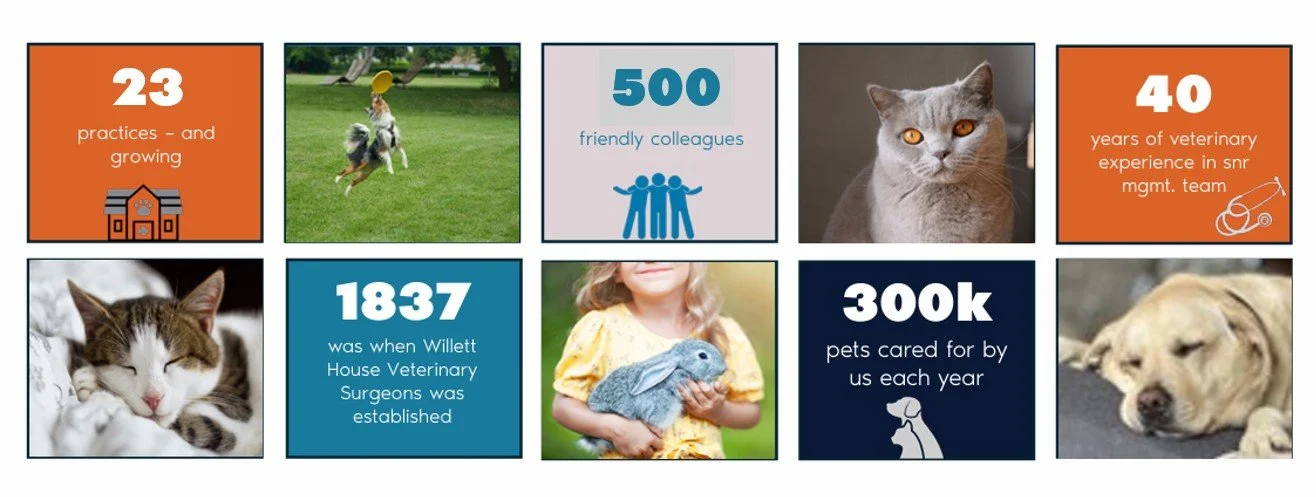
Built the internal communications approach for a growing veterinary group spanning 23 practices
Created and launched a SharePoint colleague hub, giving teams a shared home for information and updates
Advised the CEO, COO and Executive team on leadership communications, business priorities and organisational change
Helped shift the business from CEO-led communication to a more distributed model, supporting managers to communicate confidently with their own teams
Led communications for the rollout of a new workforce system, contributing to 92% colleague activation
Developed regular leadership and business communications that helped a newly formed, acquisition-built group operate with greater consistency
Bringing a growing community together
Bringing a newly formed veterinary community together - and building the communications foundations it needed to grow.
Kin had a compelling idea behind it: a different kind of veterinary group, built around collaboration, shared values and a genuine sense of community. But bringing together independently minded practices through acquisition meant that, internally, the organisation was still finding its voice.
I joined to help build that voice and the communications foundations behind it. That meant developing an internal communications approach from the ground up, creating the processes and rhythms that would give colleagues across 23 practices a more consistent experience of the organisation, while still respecting the individuality of each practice.
A new SharePoint colleague hub became a shared home for updates, resources and information for the first time. Alongside it, I introduced regular leadership communications and worked with the CEO, COO and wider Executive team to shape clear, practical messaging around business priorities, operational change and the organisation’s direction.
An important part of the work was moving communication beyond the CEO alone. Managers needed the confidence and information to communicate well with their own teams, so coaching, briefing materials and practical support became just as important as the channels themselves.
That approach proved particularly useful during the rollout of a new workforce system across the group. Clear, targeted communications helped achieve 92% colleague activation, while giving practices the support they needed to navigate the change locally.
None of this was glamorous work for its own sake. It was about giving a growing organisation the communications habits, tools and confidence it needed to feel more joined up — and making it easier for people to understand what was happening and why.